Being a great Product Leader today means much more than shipping features or managing roadmaps. It’s about communication, influence, strategic thinking, team alignment, and the ability to navigate constant change while keeping both the business and the customer in focus.
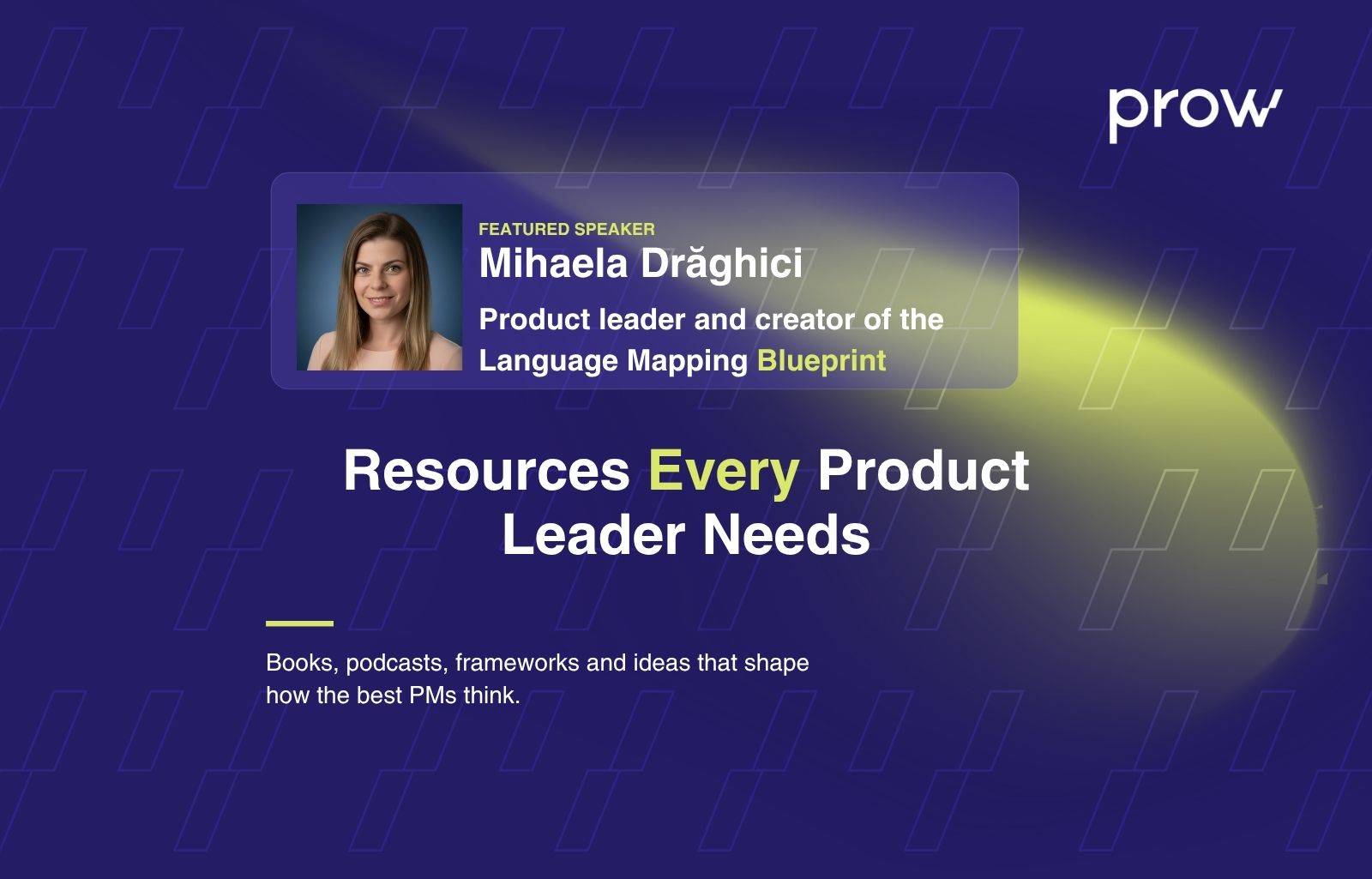
You’ll find insights inspired by Mihaela Drăghici, creator of the Language Mapping Blueprint, a framework focused on improving communication, clarity, and human connection inside teams and organizations.
The book is Tony Hsieh's account of building Zappos and more broadly, of building a company culture so intentional that delivering value to customers becomes the natural outcome of every decision, every conversation, and every hire.
What hit me hardest was this idea: you can't consistently create value for customers without building a culture that makes value creation inevitable. Not as a policy. Not as a KPI. As a default behaviour embedded in what you prioritise, what you reward for, how you communicate, and who gets promoted.
If you're a PM moving into a leadership role, or a CPO thinking about how to make great product decisions more systematic and less heroic, read this book.
This is not a product podcast. And yet this episode is one of the most useful things I listened to in 2024 for thinking about product leadership.
The parts that stayed with me:
- The distinction between leaders who make people feel safe to speak up versus those who create cultures of performance and silence
- Why psychological safety isn't a "nice to have" - it's the precondition for good product decisions
- How authority given by a title produces compliance; trust built over time produces commitment
If you manage a product team, or if you report to someone who leads through fear of being wrong, this episode is worth 90 minutes of your time.
🧠 Framework: The Ladder of Inference. The one thinking tool I use in almost every hard product conversation.
The Ladder of Inference was developed by organisational theorist Chris Argyris and popularised by Peter Senge in The Fifth Discipline. It describes how humans move, often unconsciously and very quickly, from raw data to deeply held beliefs and actions.
The ladder has seven rungs:
- Observable data - what actually happened
- Selected data - what we notice (we don't notice everything)
- Interpreted meaning - what we think it means
- Assumptions - what we assume based on our interpretation
- Conclusions - what we decide is true
- Beliefs - what this reinforces in how we see the world
- Actions - what we do as a result
The problem is that most people, in most meetings, are operating from rung 6 or 7 and arguing as if they're at rung 1. They're defending conclusions as if they were facts. And because the rungs in between are invisible, the conversation can't go anywhere useful.
Where I use this in product work:
- Stakeholder alignment meetings where two people seem to be looking at the same data and reaching opposite conclusions
- Roadmap debates where priorities feel obvious to one person and baffling to another
- Discovery conversations where the team can't agree on what a user interview actually revealed
- Conflict between teams where the real gap is in assumptions, not intent
The value isn't the framework itself, it's the three questions it trains you to ask:
What are we assuming? What did we actually observe? Where did meaning diverge?
These questions slow the conversation down just enough to find the real disagreement - rather than arguing past each other at the level of conclusions.
📺 YouTube: Teresa Torres on Continuous DiscoveryNot a channel. Something more useful.Teresa Torres doesn't have a traditional YouTube channel in the way you might expect. What she has is a body of talks and interviews that represent, in my view, the clearest thinking available on how product teams should be making decisions.
Her core argument, developed at length in her book
Continuous Discovery Habits, is that discovery is not a phase. It's not something you do before development starts and then stop. It's a practice: a recurring, lightweight, team-based habit of talking to customers and connecting those conversations to decisions.
What makes her talks particularly useful is that they're not theoretical. She's not describing an idealised process; she's describing what it looks like when teams actually do this, including the organisational friction, the resistance from stakeholders, and the common failure modes.
What to search for:- Her ProductTank talks (available on YouTube via various city chapters)
- Interviews on the Product Science Podcast and Lenny's Podcast (both have video versions)
- Her appearance at Mind the Product — sharp and practical
📬 Newsletter: Inside Product — @insideproductorg on Substack
The newsletter I've been recommending to product leaders for the past year.I'm deliberate about what I let into my inbox. Most product newsletters are repackaged frameworks, generic advice, or content marketing dressed up as thought leadership. Inside Product is none of those things.
The writing is sharp, opinionated, and grounded in the real complexity of leading product in organisations that weren't designed for it. It doesn't pretend the work is clean or linear. It talks about the political dimensions of product leadership, the stakeholder dynamics, the prioritisation fights, and the tension between what's right for the customer and what's easy to defend internally.
I've found myself sharing specific issues with peers more than almost anything else I read regularly.
🔍 Underrated (But Not Really) Resource: John Cutler
He talks about the things that actually determine outcomes."Underrated" isn't quite right. John Cutler has a significant following and has been one of the most consistently interesting voices in product for years. But I include him here because his work often gets underappreciated in conversations about PM resources, possibly because it's harder to package into a listicle.
Cutler doesn't write about frameworks you can copy-paste. He writes about the structural and systemic forces that shape how product teams actually operate:
incentives, cross-functional collaboration, organisational dynamics, decision-making under uncertainty, and what it really means to work in a system.His Substack (
The Beautiful Mess) and his Twitter/X threads have a quality I find rare in product content: they describe the messy, ambiguous, politically complex reality of working in organisations and then offer ways of thinking about it rather than false solutions.
If you've ever felt like the "product management best practices" conversation is optimising for a clean, idealised version of the work that doesn't match your actual context, Cutler is writing for you.
🔥 Hot Take: Roadmaps Don't Create Alignment. Shared Meaning Does.One opinion that might make some people uncomfortable. A PM's job is not to "manage the roadmap." It's to align the team on the meaning behind the priorities, trade-offs, and decisions it contains.
Roadmaps are documents. Like all documents, they're inert. They don't think. They don't explain themselves. They don't resolve the ambiguity behind the choices they represent.
True alignment is not agreement on a list of things to build. It's a shared understanding of:
- Why these priorities over others
- What problem each initiative is actually solving
- What trade-offs were made and why
- What "done" looks like and how we'll know
This is the PM's actual job. Not roadmap maintenance. Not status updates. The job is to create enough shared meaning that the team can make good decisions even when the PM isn't in the room. The roadmap is the output of alignment, not the mechanism for creating it.
See You at Prow Conference 2026
Prow is where Romania's product community comes together not to celebrate the clean version of the work, but to talk honestly about the hard parts: how decisions really get made, how teams actually operate, and what it takes to lead product in organisations that are still figuring it out.
If this resource stack resonates with you, we hope to continue the conversation in person.