At Prow 2026, we ask our speakers to go beyond the slide deck. What are they actually reading? What podcasts do they recommend at midnight? What's the one question they keep coming back to? This is Simina Pasat's honest, unfiltered answer.
Meet Simina Pasat
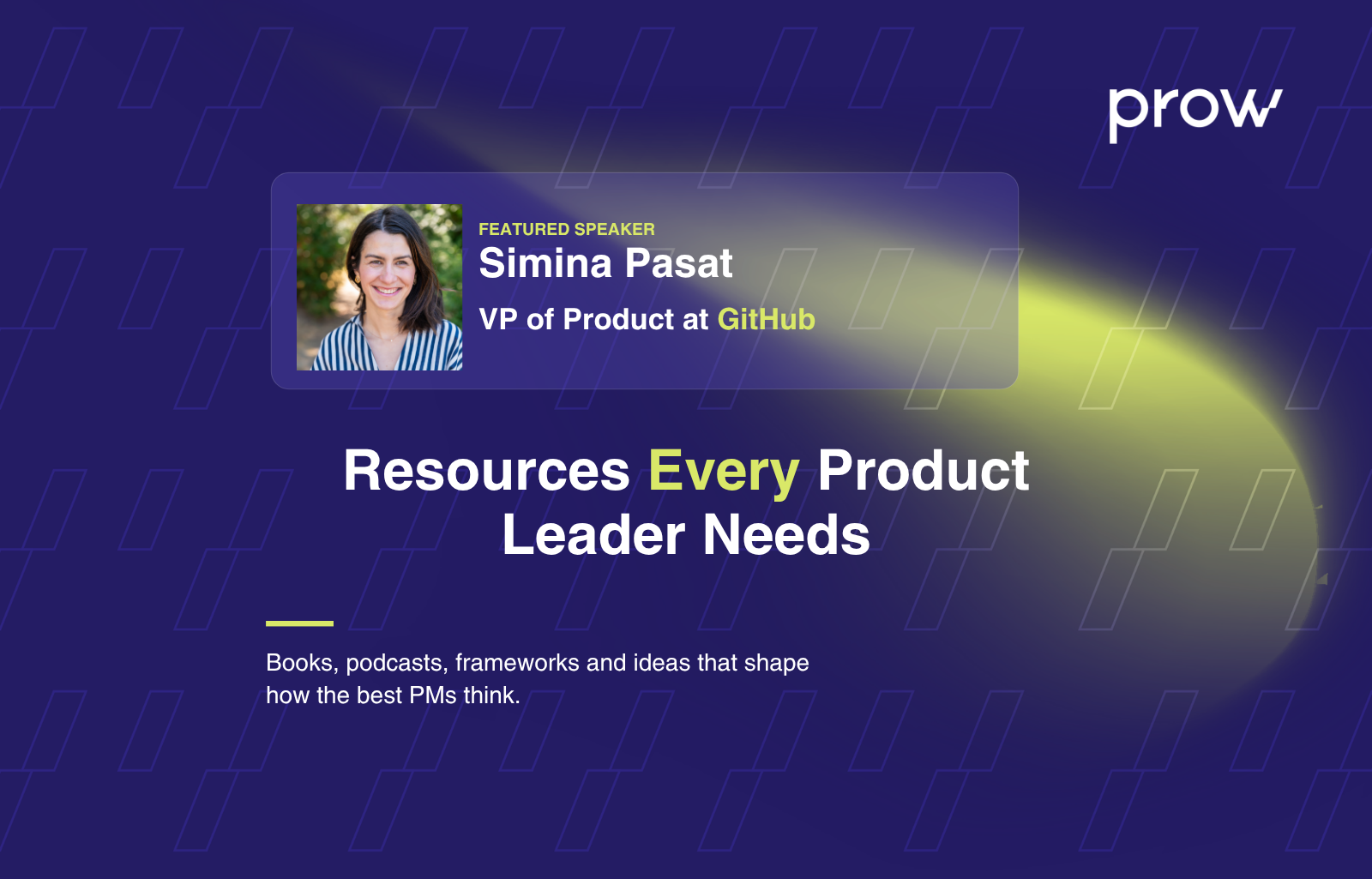
Simina Pasat is a product leader who enjoys building products that solve real-world problems. She currently serves as VP of Product at
GitHub, one of the most widely used developer platforms in the world, home to over 100 million developers.
Her background spans developer platforms, enterprise software, and consumer products, including work in the mobile space and on Xbox. In recent years, she has focused on building new experiences used by millions of developers and helping organisations improve how they build software, increasingly through AI and agents.
Simina's PM Resource Stack for 2026
We asked Simina some questions about the resources behind her product thinking the book she'd press into every PM's hands, the podcast she keeps coming back to, the framework she reaches for when conversations get complicated. Here's what she said.
📖 Book: The Lean Startup by Eric Ries
The question: What's the one book every product person should read?
Eric Ries's The Lean Startup is a classic, and according to Simina, it's more relevant today than ever. The core of the book is the build-measure-learn loop: the idea that the fastest path to a good product is not planning more carefully, but learning more quickly. Build something small, measure what happens, learn from it, and go again.
The principles haven't changed. The speed at which you can apply them has.
🎙️ Podcast: Lenny's Podcast
The question: Which podcast do you never miss? If you had to recommend one episode to start with, which one?
Simina's go-to is
Lenny's Podcast, and her reasoning speaks to what makes a podcast worth your time: the guests are consistently a step ahead of the rest of the industry.
Starter episode recommendation: The recent episode featuring Cat Wu, Head of Product at Claude Code. If you want to understand what building AI-native products looks like from the inside, this is a strong place to start.
🧠 Framework: "What's the problem we're trying to solve?"
Simina's answer here is disarmingly simple, and that's exactly the point.
"I always come back to asking myself and others: 'What's the problem we're trying to solve?'"
It sounds obvious. It's not always practised. Simina's observation is that most teams jump into solutions, features, or AI implementation before deeply understanding two things: who the target user actually is, and what user or business problem they're genuinely trying to solve.
This is one of the most common and most expensive failure modes in product development. Teams build things that work technically and ship on time, but don't solve a real problem or solve the one that actually matters to the user.
The question "what's the problem we're trying to solve?" is a forcing function. It slows the conversation down at the right moment, before the solution is already half-built, and creates the space to check that everyone is actually aligned on the problem, not just the proposed answer to it.
For product teams working in AI and agents, this mental model is even more critical. The availability of new tools can make it tempting to build because you can, not because a user genuinely needs it. The question cuts through that.
📬 Newsletter: TLDR AI Simina's pick is
TLDR AI - a free daily newsletter that covers AI developments with a level of density and curation that's hard to match.
The format is intentionally flexible: you can skim the headlines in five minutes or go deep on any story that matters to your work. For product leaders who need to stay current on how AI is evolving without spending hours doing it, this is one of the most efficient options available.
She also flags that TLDR publishes a
Product edition, worth subscribing to alongside the AI one if you want signal on what's moving across the product management space more broadly.
🔍 Underrated Resource: Reddit The question: A community, blog, tool, or person to follow that doesn't get enough credit? The answer might surprise you: Reddit.
Simina's point is not that Reddit is universally good; it's that the right subreddits, on the right topics, are among the highest-signal sources of real-world information available. When she's exploring something new or actively building in a space, she looks for subreddits where the community is genuinely engaged with the problem.
What you find there is qualitatively different from what you find in newsletters or LinkedIn posts. Real users complaining about real friction. Developers sharing unpolished workflows. Early adopters running experiments and reporting back. People are asking questions they wouldn't ask in a professional setting.
"Spending time in communities where people complain, hack together new workflows, and share experiments is incredibly high signal."
For anyone building products in a space where users are active online, which is most spaces, this is a consistently underused research tool.
🔥 Hot Take: Product Taste Is Everything
One opinion that might make some people uncomfortable.
Product taste is one of the most important - and least teachable - skills in product management.
Product taste is harder to define and harder to assess. It's the ability to look at something and know, before the data tells you, whether it's right. Whether it solves the problem cleanly. Whether the interaction is coherent. Whether the decision that seemed rational on paper is going to feel wrong to the user in practice.
It's the difference between a product that works and a product that's good.
The reason it's the least teachable is that it's accumulated, not instructed. It comes from deep exposure to a lot of products, using them, breaking them, caring about why some feel right, and others don't. It comes from working alongside people who have it. And it comes from having strong enough opinions about quality to be willing to push back when something isn't there yet.
Simina's take is that this is something product leaders should explicitly acknowledge and look for, not just in candidates, but in their teams and in themselves.
We're proud to have her at Prow Conference 2026 and even more glad she took the time to share what's actually shaping her thinking right now.
Find out more and get your ticket at prow.ro