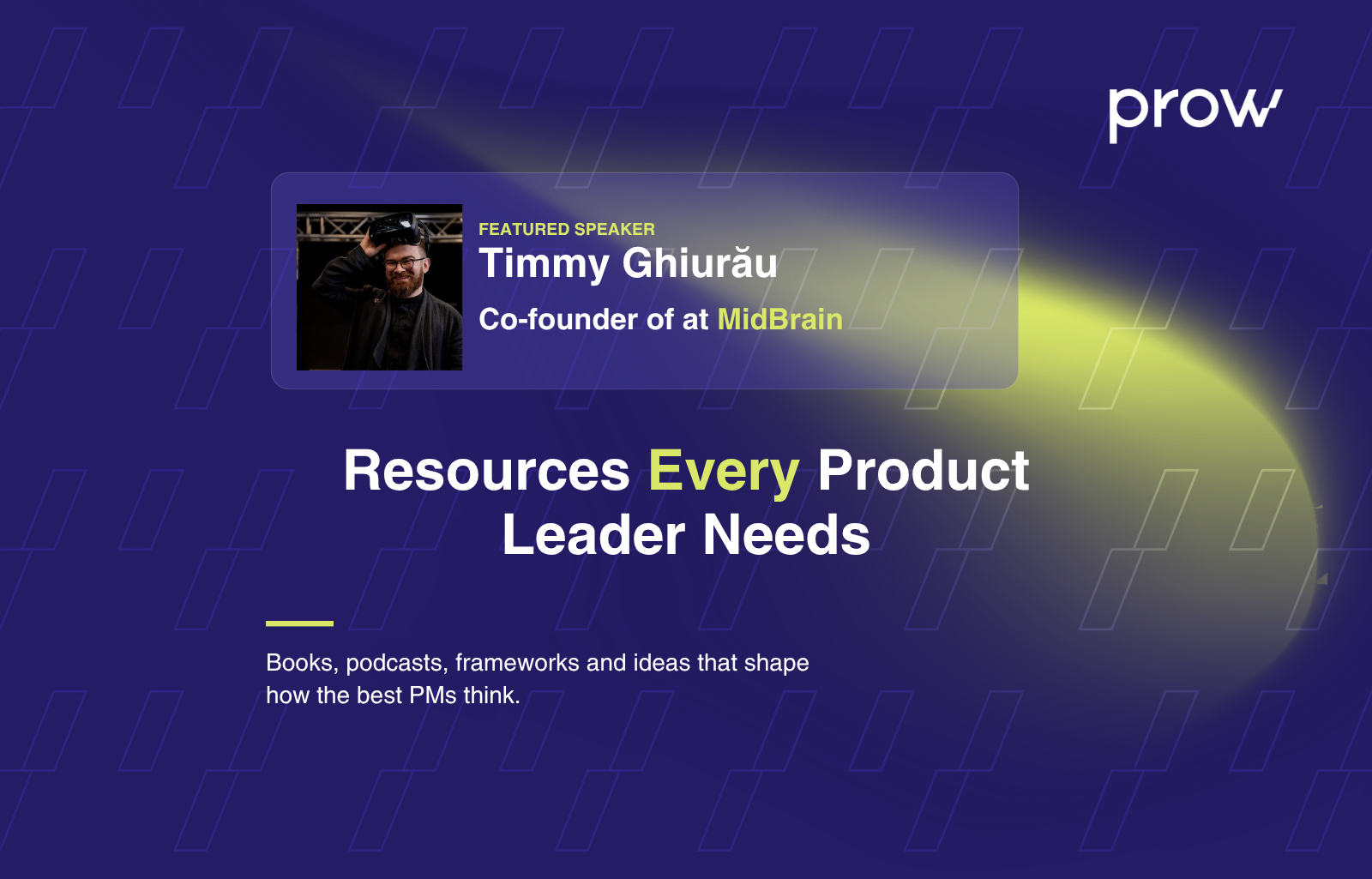
Timmy Ghiurău, Co-founder at MidBrain There is a version of professional development that looks like collecting frameworks. Stacking methodologies. Staying inside the product canon. Reading what product people are supposed to read. This is not that list.
These are six resources that have shaped how I think about creativity, about building, about the kind of mind a product leader actually needs to cultivate. Some of them have nothing to do with product management. That is precisely why they matter.
One Book How to Fly a Horse - Kevin Ashton
The most honest thing ever written about creativity: it is not magic, genius, or sudden inspiration. It is work, iteration, attention, failure, recombination, and persistence.
For anyone building products, that reframe matters. Building something new is not about waiting for the perfect idea. It is about staying close enough to the problem long enough to shape something real. Most teams do not fail because they lack vision. They fail because they stopped showing up to the problem.
One Podcast Not Investment Advice - especially the episodes with Jack Butcher
This podcast sits at the intersection of internet culture, business, creativity, and distribution — which is also, increasingly, where the most interesting products live.
Jack Butcher is exceptional at turning complex ideas into simple visual systems. That skill — the ability to take something dense and render it legible — is one of the most underrated capabilities in product work. Most product people are trained to write. Very few are trained to think visually. This podcast helps change that.
One Framework The Krebs Cycle of Creativity - Neri Oxman
I keep returning to this framework because it names something I have always felt but struggled to articulate: my work lives at the intersection of disciplines. And the best products always do.
Oxman's model maps the continuous flow between science, engineering, design, and art — not as separate domains, but as a cycle where each feeds the others. Great products do not emerge from any single discipline. They emerge when all four are in conversation. If you want to understand why truly original products feel different from everything else, this is the frame to study.
One YouTube Channel Rick Beato
Not a product channel. That is the point.
Rick Beato breaks down music, harmony, structure, arrangement, the invisible architecture of songs that work. Watching him is a masterclass in something that most product curricula never teach: taste. The ability to recognise quality, to understand why something lands, to feel when something is off.
Product people are trained to optimize. We need to also learn to discriminate. More taste, fewer frameworks.
One Newsletter Exponential View - Azeem Azhar
Products do not exist in isolation. They are shaped by the systems around them — economic conditions, geopolitical shifts, infrastructure constraints, cultural timing. A product that would have failed in 2015 can become inevitable in 2025. Understanding why requires reading beyond your industry.
Exponential View connects technology with economics, geopolitics, climate, AI, and society. It is a discipline in systems thinking applied to the present moment — exactly the kind of perspective that separates product leaders who see around corners from those who react to them.
One Underrated Resource Design Discipline -
designdisciplin.com Moderated by Mehmet Baytaș Design Discipline is a thoughtful platform on design as culture, craft, systems thinking, and responsibility. It treats design not as a deliverable but as a way of engaging with the world, which is how it should be treated.
Mehmet and I recorded an episode together at Unfinished, exploring the territory where design and product blur into each other. If you want to understand what it looks like to think at that intersection, it is worth your time.
Watch the episode:
youtu.be/z8e1w2ER90U The Thread Running Through All of This Looking at this list, there is a pattern I did not plan but cannot ignore.
Every one of these resources is about the same thing: developing a richer, more cross-disciplinary way of seeing. None of them will give you a template to apply. All of them will change how you look at problems.
That is, ultimately, what separates good product people from great ones. Not more process. Not better frameworks. A different quality of attention — one that is cultivated slowly, across domains, over time.
Stay close to the problem. Read widely. Develop taste.