Most product leaders read the same books. They follow the same newsletters, subscribe to the same frameworks, and end up thinking the same thoughts. Then they wonder why their teams hit the same walls, make the same mistakes, and struggle to see problems clearly.
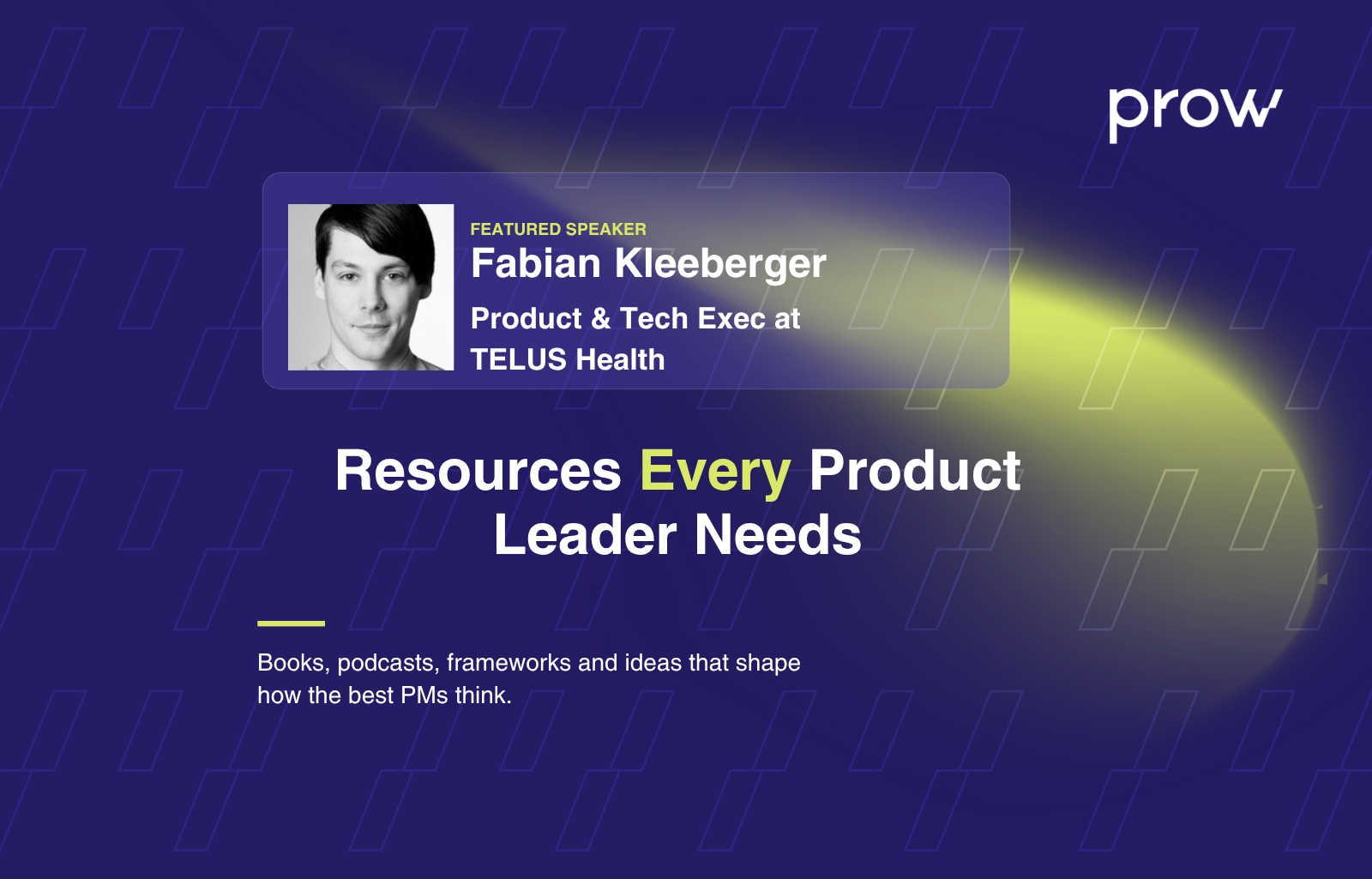
We reached out to Fabian Kleeberger, speaker at Prow 2026, and asked him to share a few simple but useful resources for someone getting into product.
As a Product & Tech Executive at TELUS Health and a speaker at Prow 2026, Fabian builds his thinking from disciplines that most product people never touch: political science, sociology, philosophy, and cognitive psychology. The result is a resource stack that looks almost nothing like the standard PM reading list, and that is exactly the point.
We asked him to fill in the blanks. Here is what he said.
1.
One Book: Seeing Like a State by James C. Scott Most product books tell you how to build better products. This one tells you how organisations lose touch with reality and why that matters more than any framework you will ever learn.
Seeing Like a State is a work of political science and anthropology, not product management. James C. Scott examines how states and institutions simplify complex human realities into systems of visibility, measurement, and control and why those simplifications, however well-intentioned, so often fail the people they are supposed to serve.
For Fabian, the parallel to product work is impossible to ignore.
"A lot of bad product work starts the same way," he explains. "The organisation becomes very good at seeing what is easy to report, while slowly losing contact with what is actually true."
Metrics replace understanding. Dashboards replace conversations. Roadmaps replace strategy. The organisation optimises for legibility, for what can be tracked, measured, and reported, while the actual customer reality drifts out of view.
Scott calls this
seeing like a state. Product teams do it every day.
Why it belongs on every PM's reading list: It reframes the central danger of product management. The risk is not that you build the wrong feature. The risk is that your entire organization gradually stops being able to see what is really happening — and you do not notice until the damage is done.
2.
One Podcast: Hidden Brain (NPR / Shankar Vedantam) Product failure is rarely a process problem. It is almost always a people problem, shaped by fear, status anxiety, cognitive bias, identity, and the stories teams tell themselves when the evidence stops supporting their assumptions.
Hidden Brain is not a product podcast. It is a psychology podcast, hosted by Shankar Vedantam, that explores the unconscious patterns driving human behavior. And according to Fabian, it is one of the most useful resources available to anyone who leads product teams.
"Product failure is rarely just a process problem," he says. "It is shaped by incentives, fear, status, group dynamics, cognitive bias, identity, and the stories people tell themselves when reality becomes uncomfortable."
Understanding why people behave the way they do, under pressure, in groups, when facing uncertainty, is foundational to product leadership.
Hidden Brain gives you a vocabulary for that understanding that no product framework will ever provide.
Where to start: Look for episodes on motivated reasoning, group identity, and decision-making under uncertainty. Each one will change how you run your next product review.
3.
One Framework: The Map Is Not the Territory This is not a new idea. Alfred Korzybski formulated it in the early twentieth century. But in product management, it may be the most consistently violated principle in the industry.
The map is not the territory. Every model is a simplification. Every simplification leaves something out.
Roadmaps, dashboards, OKRs, customer segments, conversion funnels, prioritisation matrices, these are all maps. Useful maps, in many cases. But they are representations of reality, not reality itself. And product organisations get into serious trouble when they start managing the map more carefully than the territory.
"The territory," Fabian notes, "is the customer, the market, the team, the technology, and the actual problem you exist to solve."
When a team argues about OKR definitions rather than customer outcomes, they are managing the map. When a PM defends a roadmap because it was agreed in Q1 rather than because it still reflects what customers need, they are managing the map. When a company celebrates hitting a metric that no longer tracks anything meaningful, they are managing the map.
How to apply it: Before any planning session, ask your team: what aspects of the real situation does this framework not capture? What are we not able to see because of the model we are using?
4.
One YouTube Channel: The Institute of Art and Ideas The best product thinking, Fabian argues, rarely comes from product content.
The Institute of Art and Ideas is a philosophy and ideas channel that hosts debates and lectures featuring some of the world's leading thinkers in philosophy, economics, sociology, and political theory. It is dense, demanding, and entirely unlike anything you will find in a standard PM curriculum.
"The best product thinking often starts outside product," Fabian says. "Philosophy, sociology, economics, and political theory sharpen your ability to think about systems, incentives, power, meaning, and unintended consequences."
These are not abstract skills. Understanding how systems produce unintended consequences is directly applicable to platform strategy. Understanding how power operates within institutions helps you navigate organizational dynamics. Understanding how people construct meaning explains user behavior that data alone will never capture.
"Those are much closer to real product leadership," Fabian adds, "than another video about backlog refinement."
Recommended starting point: Search for talks on rationality, institutional behavior, and the limits of expertise. The discomfort you feel is the learning.
5.
One Newsletter: The Convivial Society by L. M. Sacasas If you want to understand what your product is actually doing to the people who use it, not just what it does, but what it means,
The Convivial Society is essential reading.
L. M. Sacasas writes about the relationship between technology and human life: how the tools we use reshape attention, judgment, relationships, institutions, and the conditions under which people make meaning. The newsletter is free on Substack and consistently among the most thoughtful writing published anywhere on the internet.
It is not about product management. That, Fabian says, is the entire point.
"Product leaders should read it because products do not only solve problems. They reshape habits, incentives, expectations, and social life."
A product that solves a problem but degrades attention, erodes trust, or changes social norms in harmful ways has not succeeded, regardless of what the retention metrics say.
The Convivial Society helps you develop the conceptual vocabulary to think about those effects before they become visible in your data.
Why it matters now: As AI-driven products reshape more and more of daily life, the ability to reason about second-order effects is no longer optional for product leaders. It is the job.
6.
One Underrated Resource: Classical Sociology This is not a book, a podcast, or a newsletter. It is an entire discipline, and one that most product people have never seriously engaged with.
Weber, Durkheim, Goffman, Luhmann, Bourdieu. These are not household names in product circles. But the problems they spent their careers studying are precisely the problems that product organizations struggle with every day.
"Product people talk endlessly about alignment, incentives, rituals, trust, culture, status, language, power, and coordination," Fabian observes. "But rarely study the disciplines that have been thinking about these problems for more than a century."
Where to start: Erving Goffman's
The Presentation of Self in Everyday Life is readable, immediately applicable, and will permanently change how you observe meetings. Max Weber's writing on bureaucracy will explain more about why organizations behave the way they do than most MBA programs.
7.
Bonus: Hot Take If there is a thread running through everything Fabian recommends, it is this: the tools, frameworks, and content that most product people consume keep them thinking inside the same box. The map they are using is too small. It was drawn by people with the same assumptions, the same blind spots, and the same professional training.
The product leaders who think differently, who see problems others miss, who build things that actually change behavior, who navigate organizational complexity without losing their grip on what is real, are almost always drawing from a much wider map.
Not a better product framework. Better thinking.
_______________________
Meet Fabian Kleeberger at Prow 2026 Fabian Kleeberger, Product & Tech Executive at TELUS Health, will be speaking at
Prow 2026 on
October 30th at the Timișoara Convention Center.
Prow is Romania's premier conference for product leaders, bringing together the people who are building the future of product across Europe and beyond.
If you want to hear more of how Fabian thinks, about product leadership, organisational dynamics, and the resources that actually make a difference, this is where to be.
Tickets and full speaker lineup: prow.ro